
By Maribel Hernandez, Business Development Director, Empowered IT Solutions
Running a business in San Diego means balancing growth, local networking, and operating costs. But one risk can undo years of hard work in seconds: a single bad click.
Most business owners think of cybersecurity as another business expense. But training your employees to recognize phishing emails, suspicious links, and other common threats can prevent costly mistakes before they happen, making cybersecurity training an investment that can save your business far more than it costs.
Key takeaways:
The average SMB breach costs $120,000–$1.24 million (IBM 2025; Verizon DBIR 2025)
Multi-factor authentication blocks more than 99.2% of account-compromise attacks
Cloud sync (Microsoft 365, Google Workspace) is not a backup
Managed IT delivers CISO-level expertise without a six-figure salary
Why Human Error Is Your Biggest Financial Risk
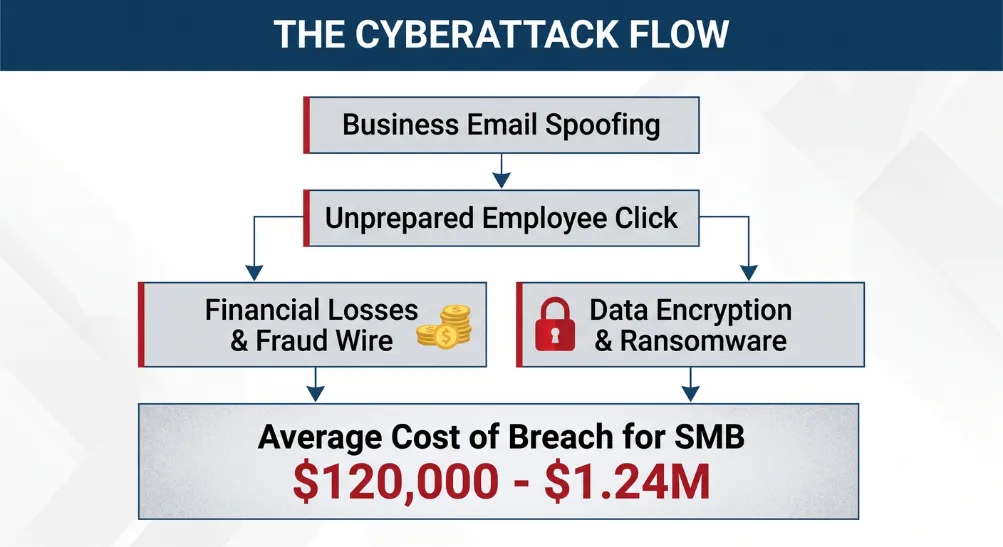
Cybercriminals rarely bother forcing their way through enterprise-grade firewalls when they can just exploit an inbox instead. Business email compromise (BEC) and email spoofing are the leading entry points for breaches at small and medium-sized businesses (SMBs).
When an employee falls for a realistic phishing attempt or a fraudulent invoice request, the fallout escalates fast:
Direct financial loss from fraudulent wire transfers
Data loss and downtime that halts operations
Costly incident response and compliance penalties
Reputational damage with local San Diego clients
How Cybersecurity Training Delivers Real ROI
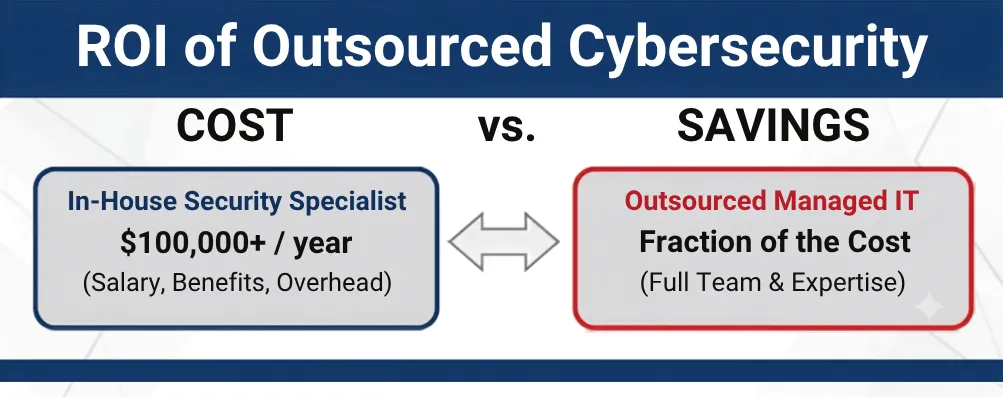
Outsourcing IT management and deploying security awareness training turns your biggest vulnerability — your people — into your first line of defense.
1. Avoiding Six-Figure Breach Recovery Costs
Preventing a breach is far cheaper than recovering from one. According to Microsoft’s own research, multi-factor authentication (MFA) blocks more than 99.2% of account-compromise attacks. When paired with routine security awareness training and running continuous phishing simulations, organizations saw employee susceptibility to phishing drop by 86% over 12 months, with a 40% reduction in just the first 90 days, per Microsoft Entra MFA documentation. Thirty seconds spent confirming a security prompt saves weeks of recovery work.
Breach recovery also carries costs that rarely show up in the first estimate:
Forensic investigation fees
Mandatory client and regulator notifications
Legal counsel
Credit monitoring for affected customers
Staff hours diverted from revenue work while systems are rebuilt
Ongoing employee training turns these unpredictable, business-threatening costs into one small, predictable line item — and that predictability is itself a form of savings. It lets you budget for security instead of gambling on it.
2. Lowering In-House Overhead
Hiring a full-time, in-house Chief Information Security Officer (CISO) or dedicated compliance manager in San Diego typically requires a six-figure salary. A local managed IT services San Diego provider, like Empowered IT Solutions, delivers full helpdesk support, day-to-day management, and complex cybersecurity and compliance consulting for a fraction of that cost — as an entire team, not one hire..
3. Preventing Disaster-Level Downtime
Saving files to Microsoft 365 or Google Workspace feels like a backup, but it isn’t. Cloud sync mirrors changes live across every connected device. Without isolated, immutable redundancy, an infected computer can wipe your cloud files right along with it.
Downtime is usually the most underestimated cost of a breach. The breach itself might be resolved in days, but the disruption, including lost billable hours, missed deadlines, and employees locked out of core systems, can stretch on for weeks. For a San Diego SMB, that’s long enough for a client to walk to a competitor before you’ve even finished recovering.
Training employees to spot threats before they execute, combined with tested backup and recovery procedures, is what keeps a bad click from becoming a multi-week shutdown.
The Pixar Backup Lesson: During production of Toy Story 2, an internal error deleted nearly 90% of the film’s files from the connected servers. The project survived only because an employee on maternity leave happened to have an isolated backup at home. Knowing the difference between cloud sync and a true backup is what separates a scare from a catastrophe.
The Empowered IT Solutions Difference
Cybersecurity awareness training should do more than check a box. Our goal is to help employees recognize the threats they may actually encounter and know what to do when something doesn’t look right.
Our training is designed to be practical, relatable, and interactive:
Real-world scenarios — We walk through phishing emails, fake login pages, payment scams, suspicious links, and other situations employees may encounter during a normal workday.
Interactive discussion — Instead of simply clicking through a prerecorded module, employees participate, ask questions, and learn how to spot the warning signs themselves.
Simple, actionable habits — Employees leave knowing practical steps they can use right away, from verifying unusual payment requests to reporting suspicious emails and protecting their accounts with MFA.
Lessons that stick — We use stories and examples to show how one seemingly harmless click can turn into an account compromise, fraudulent payment, or larger cybersecurity incident.
The goal isn’t to turn your employees into cybersecurity experts. It’s to make them more aware, more cautious, and more confident about what to do when something feels off.
Because your employees are often the first to encounter a phishing email, suspicious request, or fake login page, giving them the knowledge to recognize and respond to those threats can make them one of your strongest lines of defense.
Frequently Asked Questions (FAQs)
Why is business email compromise (BEC) the leading threat for San Diego SMBs?
BEC targets human trust, not security software. Attackers impersonate vendors, executives, or trusted contacts to trick staff into sharing credentials or approving fraudulent payments.
Isn’t cloud storage automatically backed up?
No. Cloud platforms sync changes live across every connected device. If ransomware encrypts a file or someone deletes it by mistake, that change syncs everywhere. True business continuity requires a dedicated, isolated backup.
How does managed IT save money compared to an in-house team?
In-house IT staff in San Diego come with high salaries plus benefits costs. A dedicated managed IT partner gives you an entire team — cybersecurity, compliance, and helpdesk specialists — for one flat monthly rate.
Secure Your San Diego Business Today
Protect your work, your reputation, and your operations with cybersecurity awareness training built for how San Diego businesses actually operate.
Contact us for your free cybersecurity training consultation.
About the Author

Maribel Hernandez is the Business Development Director at Empowered IT Solutions, where she helps business owners understand and navigate the complex world of IT, cybersecurity, and compliance. With a passion for making technology approachable, she specializes in translating technical concepts into practical business solutions that organizations can confidently implement.
Maribel works closely with business owners, executives, accountants, attorneys, healthcare providers, and nonprofit leaders to identify risks, strengthen cybersecurity programs, and build technology strategies that support long-term growth. Her areas of focus include cybersecurity awareness, compliance readiness, and small business technology planning.