
The High Cost of One Wrong Click: A Phishing Cautionary Tale for Small Businesses
By Maribel Hernandez, Business Development Director, Empowered IT Solutions
When small and medium-sized business owners think about data breaches, they often imagine a shadow figure hacking past firewalls using complex code. The reality is far more localized, manipulative, and devastating. It typically starts with an everyday human moment: an employee rushing through a busy morning, trying to clear out a crowded inbox.
As a family-owned business, we understand the grit it takes to build a company from the ground up. You invest years establishing your brand, cultivating client relationships, and earning community trust. Yet, in our cybersecurity training workshops, we always warn that one wrong click can make it all crumble.
This is not a theoretical warning. It is the real-world lifecycle of a modern financial phishing scam – and it is a cautionary tale every executive needs to understand.
The Anatomy of an Intercepted Invoice
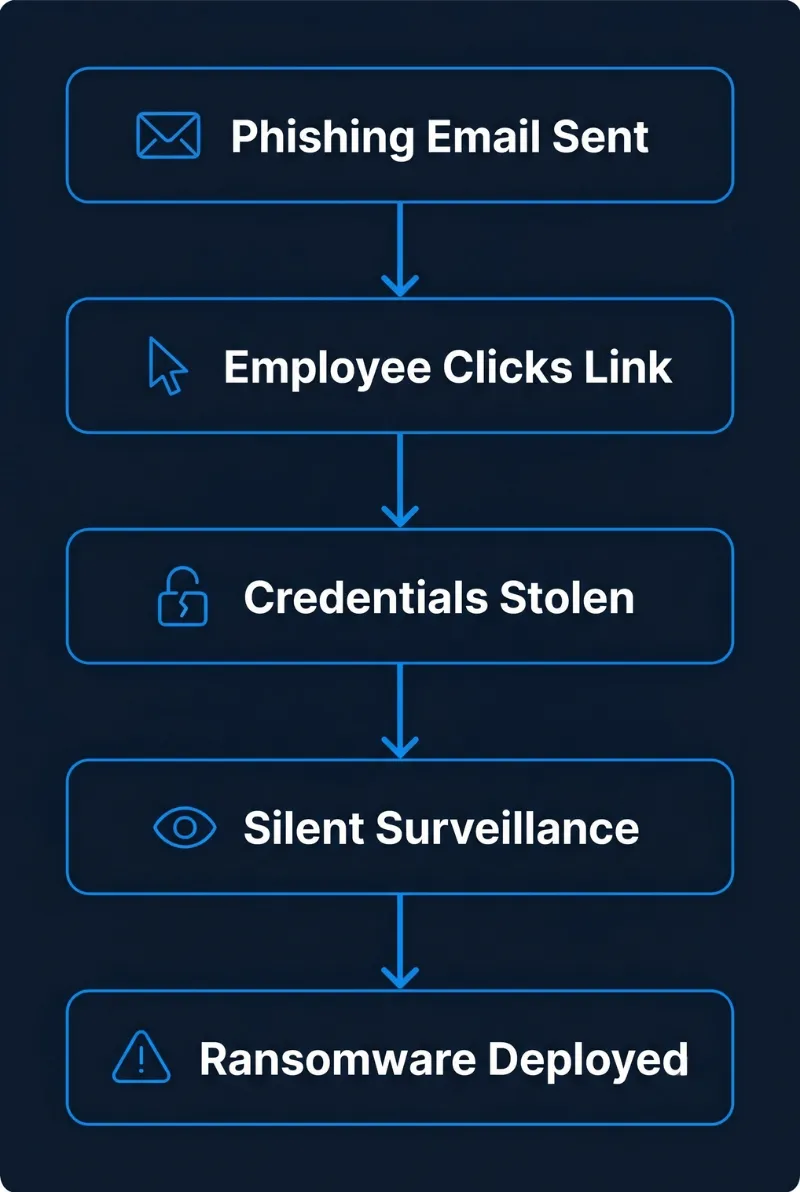
Phishing attacks targeting small businesses are not random. Cybercriminals deliberately select SMBs because they present a favorable risk-reward ratio: valuable financial data and vendor relationships, but without the layered defenses that larger organizations maintain, such as dedicated security teams, enterprise-grade email filtering, and mandatory incident-response protocols. That calculated targeting is why generic spam tactics have largely been abandoned in favor of highly personalized phishing emails designed to look like routine communications from your real vendors, utility companies, or banking institutions.
Once an employee interacts with a malicious link, the attacker doesn’t always lock down the computer right away. Instead, they begin the Silent Surveillance phase of the attack lifecycle.
Consider a standard scenario we witness in the field: An attacker gains access to a corporate mailbox and waits quietly. They read ongoing email threads, study the owner’s tone of voice, and track outstanding invoices. When a major client is about to settle a balance, the hacker intercepts the thread from a spoofed domain. They issue an updated invoice stating, “We have updated our banking details. Please route this month’s electronic payment to our new account.”
By the time the fraud is discovered, the funds have been permanently diverted overseas, leaving the small business holding the debt for services rendered.
The Ripple Effect: Beyond the Stolen Funds
Many business owners assume their liability ends with a lost payment. In California, the financial extraction is only the first wave of destruction. If a phishing scam compromises an email account containing client records, social security numbers, or health data, the event triggers strict state and federal compliance laws.
For local CPAs, financial consultants, and medical clinics, a single data breach can result in:
Regulatory Compliance Fines: Failing to maintain an updated IRS Written Information Security Plan (WISP) or violating HIPAA guardrails leads to mandatory federal penalties.
Legal Liability: Partner organizations can sue for negligence if your weak infrastructure is used to launch a secondary attack against their networks.
Reputational Loss: A reputation built over years can dissolve in an afternoon. If clients realize their confidential data was exposed due to a lack of employee training, they will take their contracts to competitors.
Moving from Reactive Recovery to Proactive Cybersecurity Management
When a firm experiences a security breach, they enter a reactive state of panic. Relying solely on ransomware recovery means you are already fighting a defensive battle after your assets have been compromised.
True operational continuity requires a proactive approach. Security must be integrated directly into your underlying business strategy, ensuring your defense architecture is completely automated, constantly monitored, and fully compliant with modern regulations.
Compliance Insight: True network protection requires a multi-layered framework. This includes advanced email filtering to quarantine malicious links before they hit an inbox, continuous dark web monitoring to spot stolen corporate credentials, and mandatory cybersecurity training for every member of your workforce.
Simple Technology, Total Security
Protecting your enterprise should not feel like an overwhelming second job. The right security stack works quietly in the background — alerting your team only when action is required, and handling routine threats automatically before they ever reach an inbox.
In practice, this means deploying multi-factor authentication across every user account, enforcing least-privilege access so employees can only reach the data their role requires, and layering endpoint detection tools that flag anomalous behavior in real time. Paired with a clear incident-response playbook, these controls give small business owners the confidence to focus on growth rather than firefighting. When an alert does surface, a designated response path — not a scramble — is already in place.
Frequently Asked Questions (FAQs)
How do financial phishing scams target small businesses?
Cybercriminals research organizations online to identify key employees who handle accounts payable or vendor relations. They send highly customized, deceptive emails pretending to be trusted suppliers, tricking employees into altering payment routing or providing corporate login credentials.
What are the legal penalties for a business data breach in California?
Beyond the regulatory fines and WISP requirements covered above, California’s own Consumer Privacy Act (CCPA) adds a private right of action — meaning affected clients can sue your business directly for statutory damages of $100–$750 per consumer per incident, even without proving actual harm. For a small business with hundreds of clients, that exposure can dwarf the original stolen payment. Prompt breach notification is also legally required under California Civil Code §1798.82; failure to notify affected individuals within a reasonable timeframe compounds both the regulatory and reputational damage.
How does cybersecurity awareness training prevent email fraud?
Cybersecurity training educates employees to spot advanced social engineering tactics, such as urgent internal requests for wire transfers, minor domain misspellings, and malicious link attachments. By turning your workforce into an active defense layer, you significantly reduce the risk of successful phishing deployments.
Don’t let a single click destroy what took years to build. Contact Empowered IT Solutions today to schedule a comprehensive security assessment for your organization.
About the Author

Maribel Hernandez is the Business Development Director at Empowered IT Solutions, where she helps business owners understand and navigate the complex world of IT, cybersecurity, and compliance. With a passion for making technology approachable, she specializes in translating technical concepts into practical business solutions that organizations can confidently implement.
Maribel works closely with business owners, executives, accountants, attorneys, healthcare providers, and nonprofit leaders to identify risks, strengthen cybersecurity programs, and build technology strategies that support long-term growth. Her areas of focus include cybersecurity awareness, compliance readiness, and small business technology planning.